
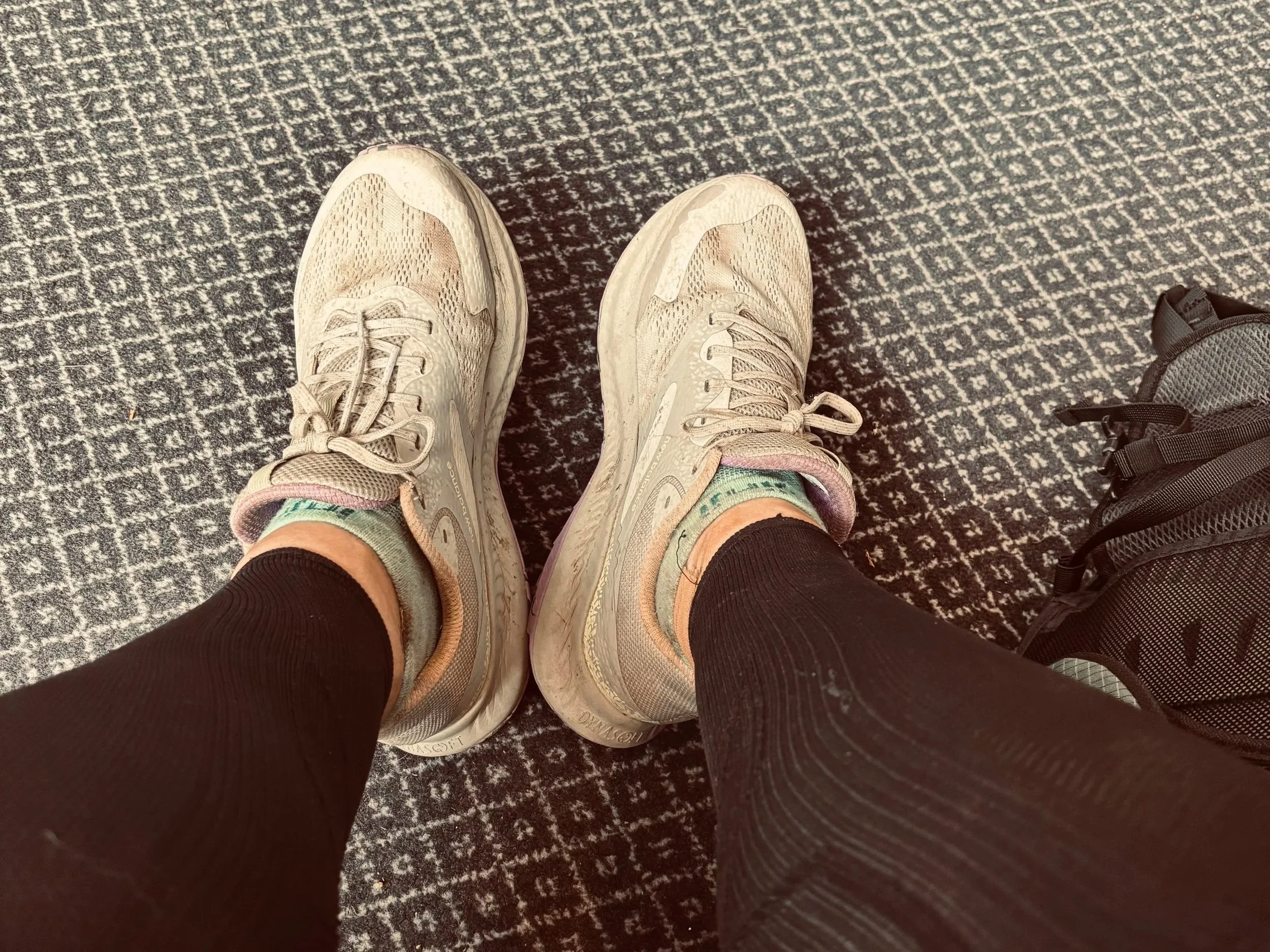
Because there is no such thing as the perfect walking shoe — only the shoe that is right for your feet, your walk and the conditions you’re about to meet.
There is one piece of advice I’ve learnt to be particularly careful about when preparing for a long-distance walk:
Wear the shoes that work for your feet
It sounds obvious, doesn’t it?
But spend enough time researching long-distance walks and you’ll quickly discover that everyone has an opinion about footwear. Trail runners. Hiking boots. Waterproof boots. Sandals. Lightweight shoes. Heavy-duty shoes. Wide fit. Narrow fit.
And somewhere amongst all those opinions, it’s very easy to forget one rather important thing.
Your feet are yours
No two people have exactly the same feet. In fact, not even our own two feet are necessarily identical.
I’m certainly no footwear expert. But after walking Sarria to Santiago, most of the Portuguese Camino from Porto to Santiago, the Cotswold Way and, more recently, 130 kilometres of the Via Francigena through Tuscany, I’ve discovered a few things I never really thought about before I started walking long distances.
And, inevitably, I seem to learn something new every time.
Start with the walk, not the shoe
Before you start looking at footwear, look at the walk.
How far are you hoping to walk each day?
Are you going to be walking 10–15 kilometres, or are you planning on regularly pushing beyond 20?
What is the terrain like?
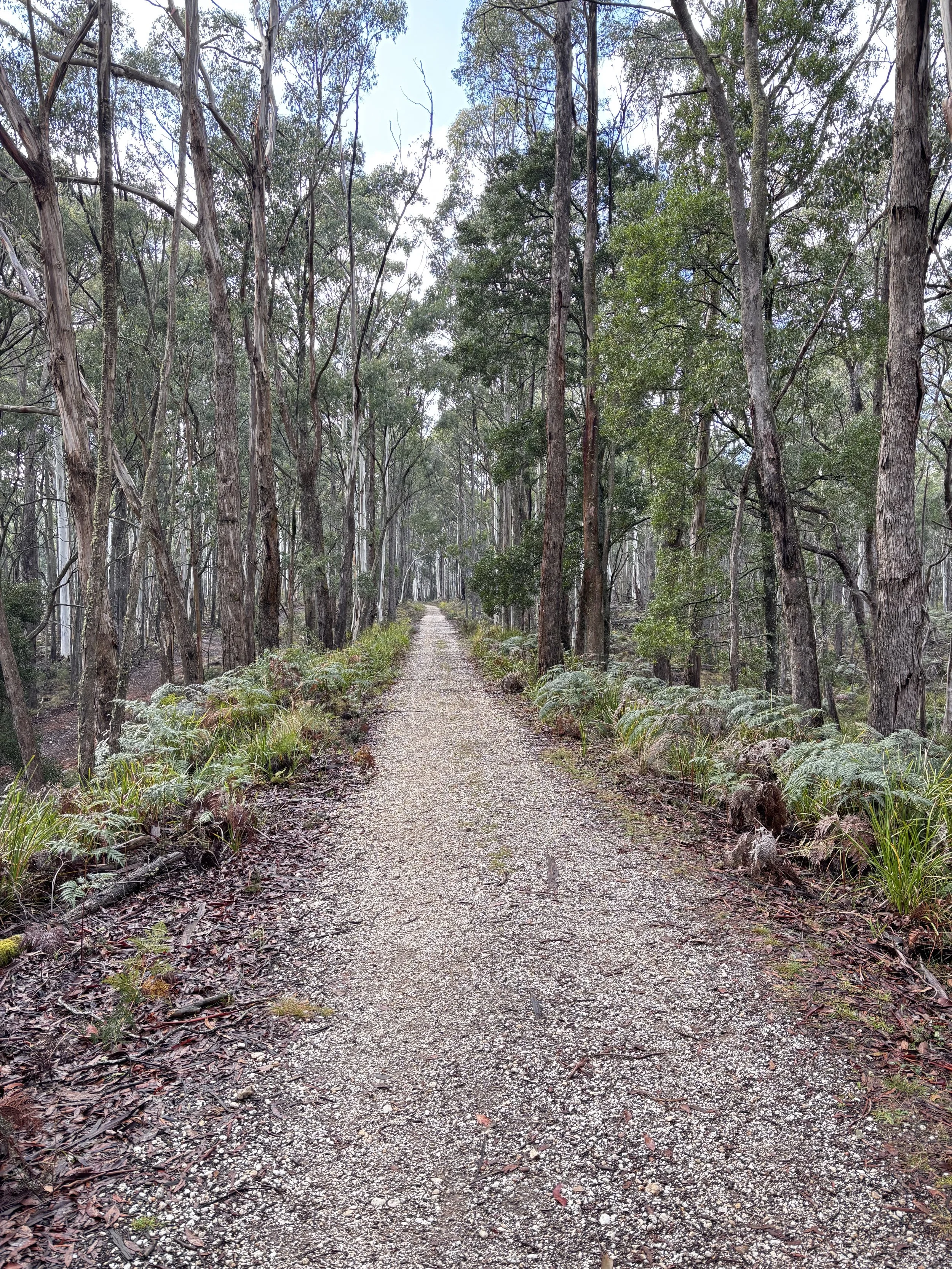
Are you walking on paved roads, cobblestones, forest tracks, rocky paths or muddy trails?
And perhaps most importantly: what will the weather be doing?
Your perfect shoe for a summer pilgrimage through Spain might be a terrible choice for a wet winter walk through the English countryside.
Think about the weather
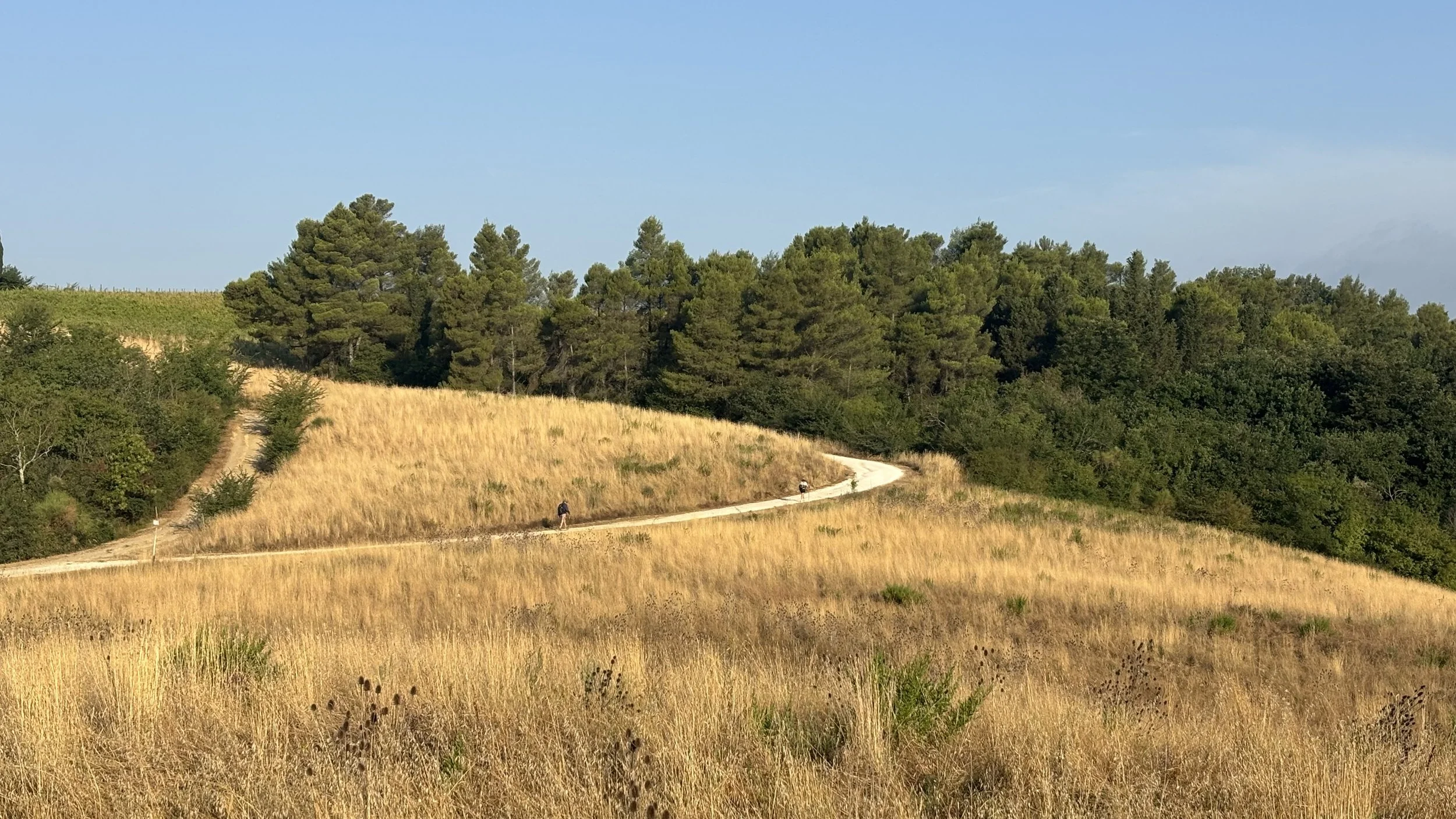
This one has become increasingly important to me.
If I’m walking somewhere in summer, particularly where temperatures are likely to climb above 30°C, I’d be looking towards something lightweight and breathable. A trail runner can be fantastic. And yes, I’m also perfectly happy to consider sandals.
Sandals. With socks.
There, I said it.
If that combination keeps your feet comfortable, who cares what anyone else thinks?
On a hot walk, your feet are going to sweat. They may also swell. A lightweight, breathable shoe can make an enormous difference.
I’d even think about the colour of your shoes.
This sounds ridiculously superficial until you’ve spent hours walking in the hot sun.
A light-coloured shoe is simply not going to absorb as much heat as a very dark one. And when your feet are already hot, sweaty and swollen, every little bit helps.
The material matters too. Leather can be beautiful and wonderfully durable, but it doesn’t have the same give and breathability as mesh or other lightweight materials.
Then there’s winter.
If you’re expecting cold, rain, mud and potentially miserable conditions underfoot, waterproof footwear might suddenly become much more appealing.
Although even here, there’s a trade-off.
Waterproof shoes can keep rain and puddles out, but they can also hold heat and moisture in. And once your feet are wet from sweat, you’ve got a different kind of wet-foot problem.
There is no perfect answer.
There is only what works best for your walk.
Consider going up a size
This is something I probably didn’t appreciate enough when I first started walking long distances.
Your feet swell
After hours of walking, particularly in warm weather, your feet can become noticeably bigger than they were when you tried your shoes on in the shop.
For that reason, I’d consider trying a shoe that is half a size, or even a full size, larger than your everyday footwear.
You don’t want your toes hitting the front of your shoe every time you walk downhill.
And if you find you’ve gone slightly too big?
You can always add another pair of socks.
It’s much harder to create extra space in a shoe that is too small.
Just remember that bigger isn’t automatically better. Your heel still needs to be secure and your foot shouldn’t be sliding around inside the shoe.
And don’t ignore width
Even if you don’t consider yourself to have wide feet, I’d still look at whether a wider fitting is available.
Again — swelling.
Your feet can change throughout a long walking day, and giving your toes a little room to spread can make a surprising difference.
I’ve become much more conscious of having enough room across the front of my shoes. Your toes need space to move, particularly when you’re walking downhill and putting repeated pressure on the front of your foot.
Your shoes shouldn’t feel like they’re squeezing your feet into submission.
How many pairs do you actually need?
This is where my approach has evolved.
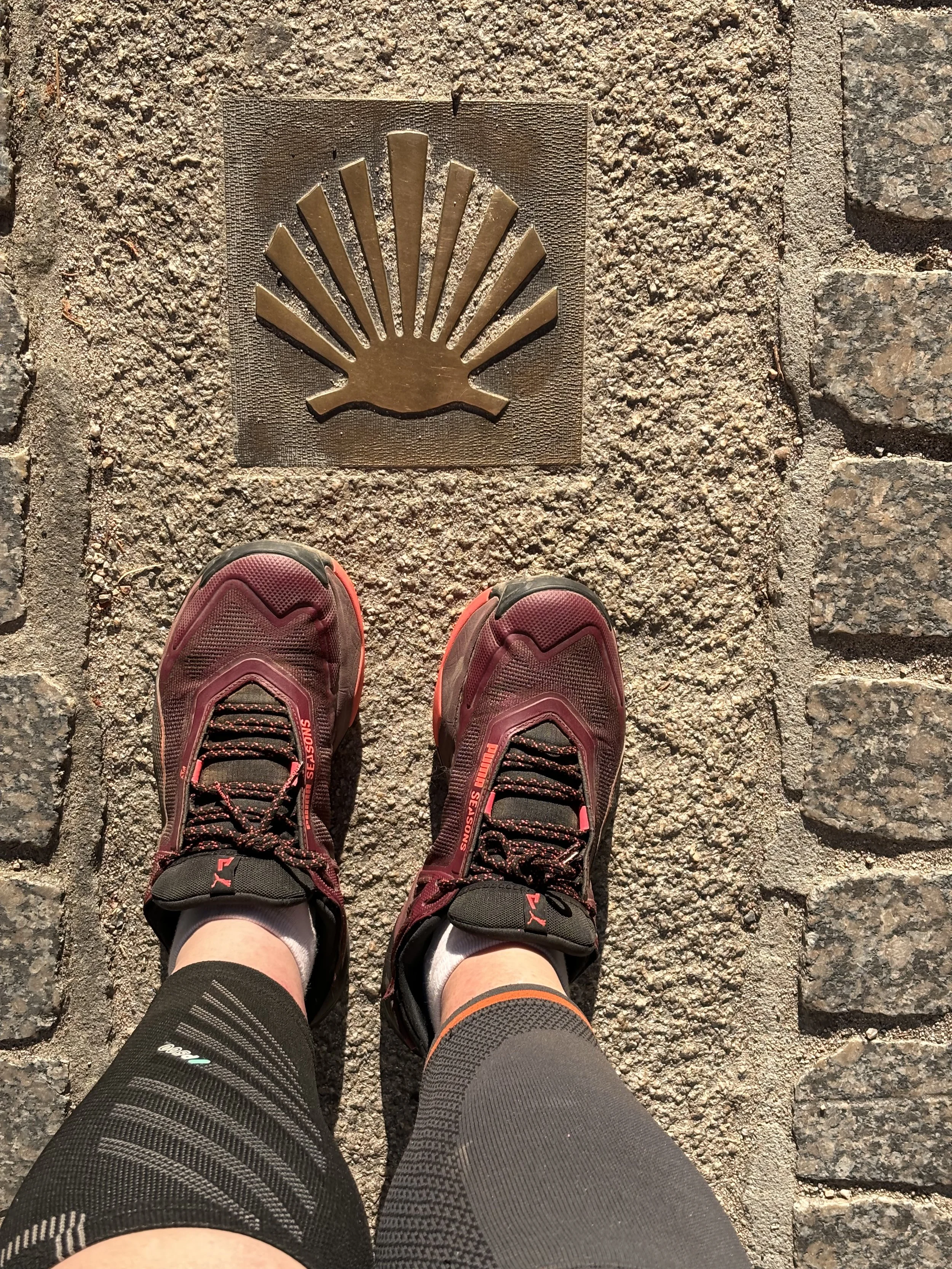
For my long-distance walks, I’ve generally worn trail shoes.
They’ve got me through Sarria to Santiago, most of Porto to Santiago, the Cotswold Way and my 130-kilometre Via Francigena walk.
And one of the things I love about trail shoes is that they don’t necessarily become walking-only shoes.
They’ve also been my main shoes when I’ve been wandering around towns, sightseeing, catching trains and doing all the other things that happen around a walking trip.
That means I don’t necessarily want to carry multiple pairs of heavy shoes.
For the last couple of walks, though, I’ve added a pair of travel sandals to my luggage.
They’ve become my evening luxury.
After a day on the trail, taking off your walking shoes and letting your feet breathe is wonderful.
On the final day of the Via Francigena, I even became a socks-with-sandals gal.
And you know what?
I’d absolutely do it again.
In fact, if I were walking in summer and expecting temperatures consistently above 30°C, I’d seriously consider whether sandals might become part of my daytime footwear rotation too.
Break them in. Please
This one shouldn’t need saying, but it does.
Don’t make your first day of a long-distance walk the first day you wear your shoes.
Walk in them.
Walk around the neighbourhood.
Wear them shopping.
Take them on a shorter hike.
Find out where they rub.
Find out what happens when your feet swell.
Find out whether your heel slips.
Find out whether your little toe starts complaining after ten kilometres.
Nothing beats having shoes that have been worn in and have started to mould themselves to your feet.
But here’s the thing I’ve learnt the hard way:
Even broken-in shoes don’t guarantee blister-free feet. - Your socks matter too
I’m a big believer in good quality wool socks.
Personally, I use Injinji toe socks, usually crew length, but the important thing here isn’t necessarily the brand.
It’s finding socks that work for your feet.
And I don’t wait for a blister to appear before doing something about it.
If I know there are particular places that tend to become hot spots — for me, that’s often my heels and the outside edges of my feet — I’ll tape them before I start walking.
I also use a little preventative Vaseline and hikers’ wool around areas such as my big and little toes.
It might seem like overkill when you’re standing at the beginning of a walk with perfectly happy feet.
It won’t seem like overkill eight hours later.
And then there are blisters ….
Despite all the planning in the world, sometimes you get one.
That’s walking.
Your feet are doing something they’re not necessarily used to doing for hours and hours, day after day. Even the perfect shoe, perfect sock and perfect preparation can’t guarantee that you’ll escape completely unscathed.
The trick is to pay attention.
A hot spot is your warning.
Don’t ignore it because you’ve only got another five kilometres until lunch.
Stop.
Take your shoe off.
Have a look.
Tape it if you need to.
Because five minutes of attention early in the day can save you from a miserable afternoon.
There is no perfect walking shoe
After several long-distance walks, I think this is probably the biggest thing I’ve learnt.
The shoe someone else swears by might be completely wrong for you.
And that’s okay.
Your feet are different.
Your walking style is different.
Your route is different.
Your daily distance is different.
Your weather is different.
So rather than asking “What are the best shoes for long-distance walking?”, perhaps the better question is:
“What do my feet need for this particular walk?”
Think about the terrain.
Think about the distance.
Think about the weather.
Think about swelling.
Think about width.
Think about what you’ll be doing when you’re not actually walking.
And, most importantly, listen to your feet.
They are going to carry you a very long way.
After all, when you’re walking hundreds of kilometres, they’re really the ones in charge.


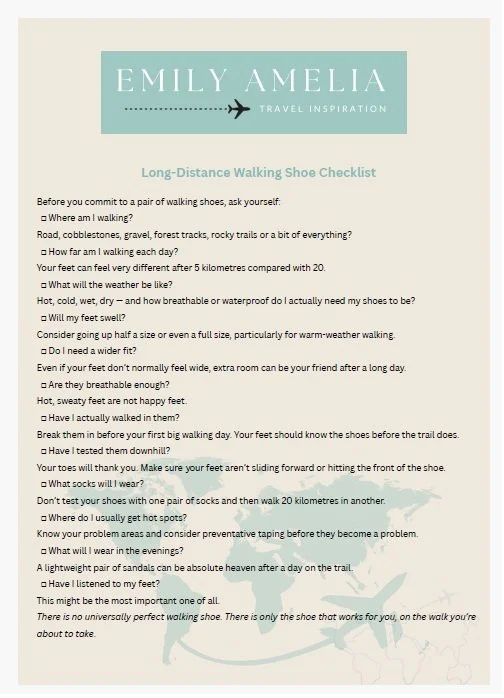
Download your own long distance walking checklist below
Ensure that you stay connected while travelling with Simify’s eSims - Find out more now
This page contains affiliate links, meaning we may earn a commission at no extra cost to you - thank you for supporting our work!
